Healing happens where there is a meeting. To truly unburden and release the pain our parts have been carrying, they must be met, received, and witnessed.
What I’ve observed from my forays into many different modalities is that there are variations and themes in who is doing the witnessing. I’m fascinated when frameworks emerge from the chaos, and this one has been bubbling for a while.
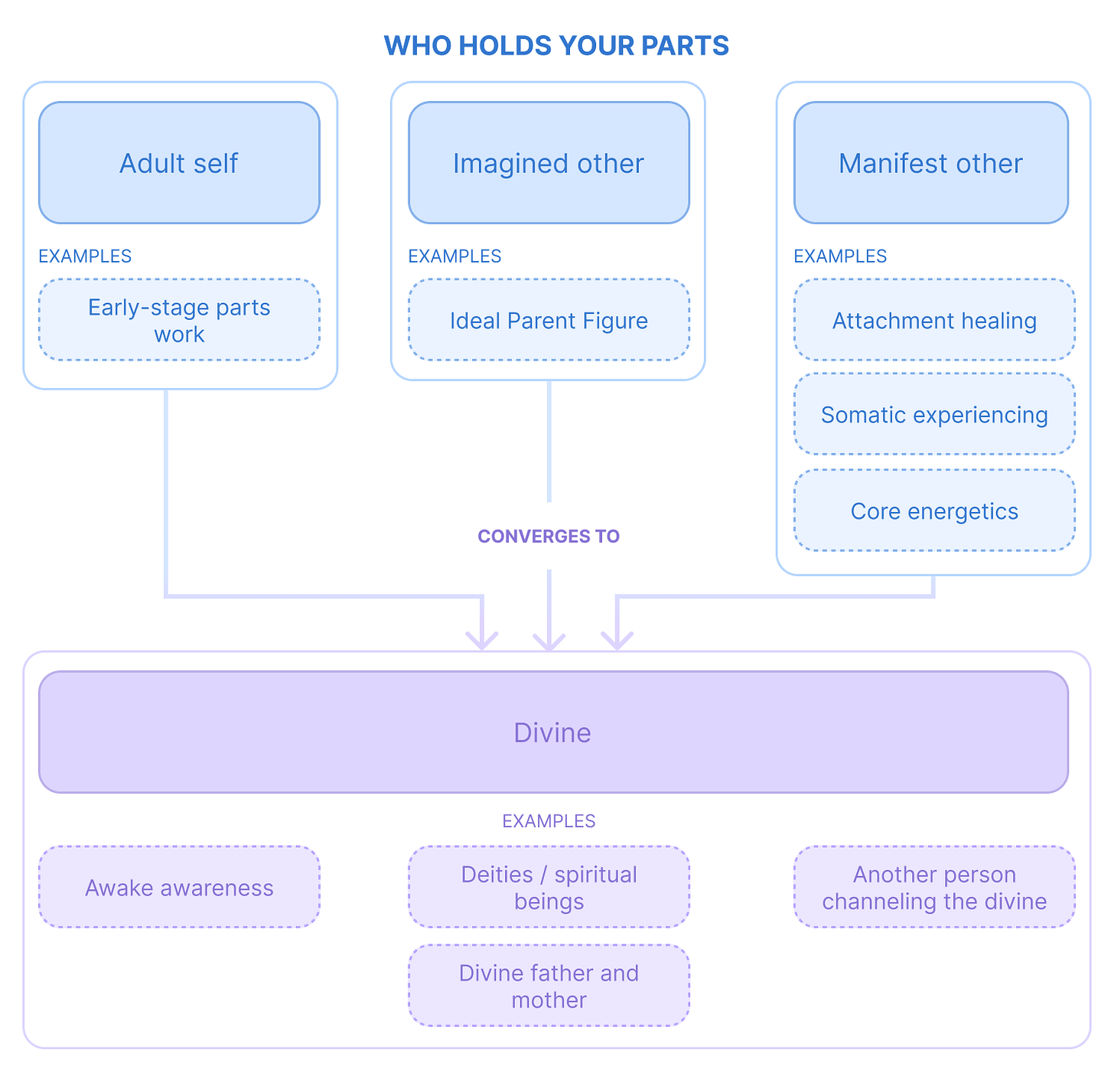
There are so many nuances that are hard to capture, but this is an attempt. I want to speak to the three foundational levels of meeting (adult self, imagined other, and manifest other), and how everything converges to the divine.
[

The three foundational levels
Your own adult self is where many people start. It is one of the first steps into deeper resourcing – sometimes called tapping into your inner witness. It is learning that there is a You beyond your parts, and showing your younger parts that they can be seen and met by a presence that is not caught up in their fears.
Imagined other is when instead of your adult self meeting your parts, you imagine another being meeting your parts. It could be someone you know, a spiritual being, or something like an Ideal Parent Figure.
Manifest other is when a real human is present with you witnessing your parts.
Imagining another being activates a different pathway
Early on in my journey with Ideal Parent Figure, I was enthusiastically describing it to someone close to me. I don’t know, he responded dubiously, the whole point is that I don’t trust authority figures. Why would I trust ideal parents? I’d much rather imagine myself holding my younger parts.
What I’ve observed from holding many people through the Ideal Parent Figure protocol is that imagining that someone else is there with you activates your attachment conditioning in a different way than imagining your adult self. It bypasses some of the self-reliance that can be sticky as you’re starting to meet your parts. It can activate trust issues as you slowly let your ideal parents in. It can bring a deep sense of relief that just relying on your own adult self doesn’t quite touch.
You can try it now. First, imagine yourself at your most resourced, giving yourself a hug. And then, imagine someone you love – someone who is not you – giving you a hug. What do you notice? For me, they have two different qualities. Imagining giving myself a hug feels good, self-caring, and resourcing; and yet imagining receiving a hug from a being who is separate from me feels deeper, more nourishing, and takes more effort to really let in.
Often, imagining ideal parents is triggering in a way that being with ourselves isn’t. It activates a sense of being in our earliest, most foundational relationship, and all of the beliefs and hurt and pain that come with that. It reminds us (in ways that we often don’t want to be reminded) that our wounds are relational, and that healing is relational. And as much as we want to avoid it, that avoidance is a pointer to where loving awareness most needs to go.
We heal in connection
I recently began a training with an amazing attachment healer, Peter Cummings. His training, called the Adult Attachment Repair Model (AARM), revolves around a literal, physical stick. As the healer, you hold out a 3-foot-long stick for your client to hold alongside you. In their response, you can read the entire history of their attachment – do they hesitate? Are they afraid to hold it? Do they push, or pull? Do they pull, and then let go in disbelief? It somewhat mystically bypasses our narrative minds and goes straight to our somatic conditioning. As a recipient of the stick method, I can affirm that I’ve grabbed onto that stick and immediately started crying as my attachment wounds played out.
One of Peter’s core philosophies is that pain needs to be witnessed. As the healer, you step into being a surrogate attachment figure. You provide the secure attachment someone needed growing up – meeting all of their emotions, holding them with the reverence they deserve, seeing their true selves, being with them through the emotional waves. Witnessing not only the pain of the wounds, but also the pain of the wounds not being treated with the seriousness they merited.
In my energy healing training program, there’s a similar philosophy. Attachment wounds happen in relationship, my teacher says, and need to be healed in relationship. She moves through awareness space to find right where our little ones are hiding, and brings the presence of the ideal mother as she holds us there.
I get the sense that healing through a surrogate attachment figure has gotten a bad rap. Images of old white men in stuffy offices appear, with the words “transference” and “Freudian” floating around. There is a deep vulnerability in truly acknowledging that someone else is showing up, with a regulated, secure nervous system, to fully hold and meet you. And there is much more involvement from the healer. The healer’s self is fully there, shadows and all – not as an observer or facilitator, but as a crucial participant.
In my work with clients, I can often feel the way they hold back from acknowledging the connection. It’s like being in a room with a group of loving people around you, with your eyes held tightly shut, pretending you’re alone. It’s usually not even conscious – it’s just a habitual pattern. If our attachment figures (and the humans we’ve encountered since) haven’t felt safe to be truly authentic with, we may be in the connection without really acknowledging to ourselves that we’re in connection. It’s a lonely place, but a safe one.
You can be with someone yet energetically disconnected from them. You can be talking, engaging, laughing, but have your field pulled back so that it isn’t making contact. And then there is a moment when your field joins another’s, and the nourishment begins to flow freely between them. It feels denser, richer, more like ambrosia swirling between two beings.
Sometimes, I’ll nudge them to notice that I’m there with them. There’s a moment of incredible vulnerability (the opening of the eyes, realizing someone is really and truly there, that you are sharing a field), and then, often, a softening. Oh. There you are. I am not alone.
The collective wound of independence has pushed us away from healing in relationship with each other. It is so much easier to feel through our emotions on our own (I don’t need anyone else, right? I can just process this myself?) or turn to solo solutions like AI apps. Both of these absolutely have their place. And yet, in the vulnerability of turning to another with our messy emotions and letting our fields touch lies some of the deepest healing.
Everything converges to the divine
When you touch something with awake awareness, my Dzogchen teacher says, it liberates. You can meet a wound from a part, from the subtle awareness that is aware of the part but still localized as a separate self, or from the boundless awareness that has no center, no edges, no separation. When you meet it with true emptiness and cut through it with the Truth of who we are, its grip loosens.
As I’ve traversed the different modes of healing (self, imagined other, manifest other), I’ve been delighted to discover all of them are doorways into a relationship with the divine. If you follow along any one path long enough, you end up touching into the deepest source of healing and wholeness: our true nature.
When the self becomes divine, we heal from the infinite field of love and boundless awareness. Everything is okay. There is no limit to the resourcing, because awareness is unlimited. When the imagined other becomes divine, we call in the energies of the divine mother and the divine father; we pray to deities and spiritual beings; we allow ourselves to receive the ambrosia that envelops us. We are held in a loving presence that never wavers. When the manifest other becomes divine, they offer a portal to infinite love and awareness that we can rest into. They hold our hand as they open into awareness without bounds, allowing it to flow through their veins and into ours.
One person cannot hold the full extent of another’s emotions. We are human, fallible, limited. But if we open ourselves up to the divine, we become a vessel; we allow the ocean of love to flow through to those who most need it. And in this place of divinity, all modalities blur together and there is just the love that never dies.